Saturday, March 31, 2018

John Henry Analysis Paralysis

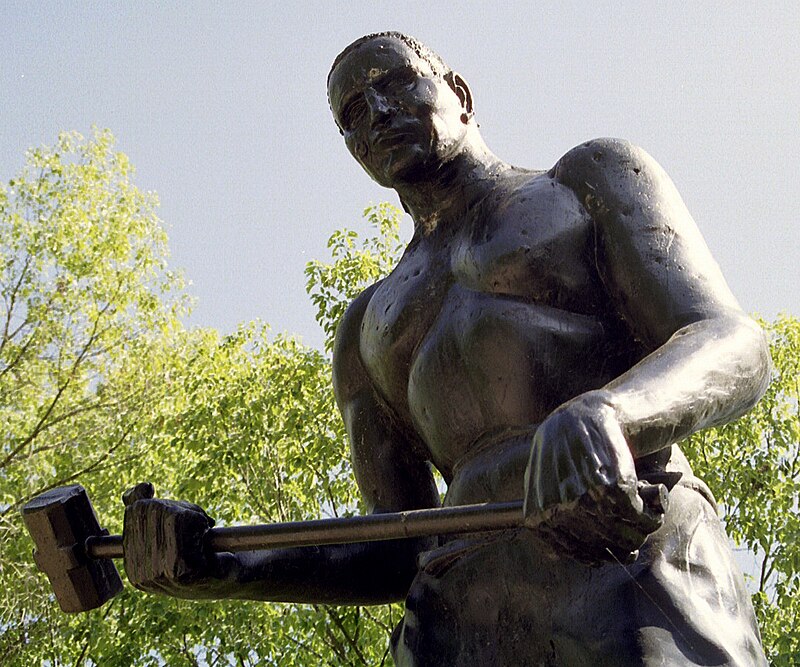
Did you know that John Henry, the "steel-driving man" of American folklore, actually existed and did in fact beat a steam-powered hammer sometime in the early 1870s, though he probably did not die from exhaustion immediately after his victory. Sadly, he very likely was worked to death as a convict leased out to the C&O Railway Company, his lungs lacerated by the rock dust he would have breathed in constantly as part of his work. How did he beat a machine? Simple--the machine was something of a rudimentary prototype, and it worked very poorly. Just a decade of refinements to the technology later, argues William and Mary scholar Scott Reynolds Nelson, and such a victory for the human would have been inconceivable.

This is a stretch, but I have esteemed myself something of a John Henry this semester in my internship project for the Florida Historical Quarterly. Largely duplicating the efforts of an earlier digital humanities project, I have meticulously-logged all 1,794 FHQ articles from the first volume in 1908 to the most recent third issue of volume 95. Why? Two reasons. 1) I wanted to perform a close survey of all 95 volumes, to get something of an intimate feel for the first century of the Quarterly, and 2) I do not yet trust optical character recognition (OCR). It does fine more than 90% of the time, but somewhere between 1 in 10 and 1 in 20 words get garbled, and for me, that still has the human winning the race.

So now I have an index, in chronological order, of some 1,800 featured articles (excluding all the book reviews), and now I have to figure out a meaningful mode of analysis, and on the double. I know I want to categorize them, and have the flexibility to acknowledge overlapping categories, e.g., Native Americans, economics, Seminoles opening a casino is both. My problem is figuring out what categories to go with, because once I start, I don't want to get to article 650 and realize I should have been tagging articles of x type. To a great extent this is a crystallization of the whole historical project: you analyze a topic in history, anxious not to miss something, but you have to remind yourself that a solid contribution is a far more realistic and likely worthy goal than the definitive, fully-exhaustive treatment. We will always miss angles of analysis, and all to the good; it gives our colleagues and posterity something to do with their scholarship. Now, time to get back to driving these spikes...

Sunday, March 25, 2018

...(Post) Secondary Education Continued...

In my last embarrassingly-wordy and somewhat stream-of-consciousness post, I enumerated six principal stakeholders involved in high school education:

1) State Department of Education
2) Scholars in higher education
3) County and school administrators
4) Teachers
5) Students
6) Parents

While higher education does not have to deal with *quite* the level of bureaucratic oversight, they have their own initiatives, endowments, and strategic vision hoops to jump through, so both groups may benefit from some reflection on the principal concerns of each of these groups. Let's take a blog-level survey:

Any state department of education has one major consideration the other groups do not, at least to near the extent: politics. They have to worry about cultural bias in math questions, so you better believe those near the top of bureaucracy are deeply concerned about minimizing the angry op-eds from parents decrying the marginalization of one group, the anti-American bias, the American gloss, etc...If someone in a state (or the federal) Department of Education cannot acknowledge the tension this creates between sound pedagogy and wise statecraft, that is a huge red flag.

As a general rule, scholars in higher education are probably the most difficult subjects of generalizations. This is more a hunch based on a smattering of anecdotes, but it seems that academics either esteem themselves primarily as writers or primarily as instructors (though perhaps some like to fancy that they maintain a perfect complimentary harmonization of the two). For those who primarily identify as writers, conscience rather than passion will dictate what they do with their students. For those who primarily identify as instructors and mentors to students, writing will likely come in fits and starts--too much tinkering with lectures competes with the research. I can't resist pointing out that given the universe's manifold ironies, there is only partial correlation between an academic's primary identification and which of the two is where his or her greatest contributions come. Extraordinary orators can feel perfunctory as they give high quality lectures, gifted writers can crank out high-impact scholarship in an almost desultory manner, and sadly the inverse of each of those. What does it matter? If you are working with a professor, it is respectful, and practically wise, to know which aspect of the profession gives him/her the most gratification.

County and school administrators are concerned with local politics, which includes internecine issues between the different parts of government. City councilors can threaten the job security of school board members, so you better believe that there are issues that bleed into what is required from local school boards and principal offices. The biggest difference between the county and school administrators is the proximity to the classroom, and therefore the ability to recognize what effect (if any) a policy may have on what teachers and students do. It is a sad truth that many pace guides, model lesson plans, and other support materials are produced at the county level and never get downloaded from the server on which they were first created.

Teachers come in two basic types: the inspired and the disaffected. If you are a student or parent, do your best to find out tactfully who the unquestionably inspired teachers are in your school, because getting them will make a world of difference in the student's education. It is unlikely you will get anyone to cast aspersions on any teacher, so don't try to find out who is jaded, though you'll hear some rants that give you enough information to have a pretty good idea.

Students, like teachers, are essentially binary: motivated or not. It is simply stunning how many educators are content to only worry about the motivated. While I understand the temptation, it belies some intentional amnesia about the experience of life from 5-18 years old. Even if you have always been a naturally curious, self-motivated student, there were some areas of life you needed some graciousness, and were not helped by "tough love" that refused to extend to you any of it. Think of the kids who are missing out on your subject because of a lack of inspiration, and try to sympathize and supply it. I have known of several teachers how were able to teach a lot to unmotivated students almost solely because of the compassion they showed them at the situation of having to learn things you're not interested in.

Finally, parents: universally they want to know that you care about their children. Some rationalize dishonesty and disregard for anyone not in their family when dealing with educators, but even when they fight dirty, they're way more inclined to accept defeat if you repeatedly demonstrate and verbalize your concern for the student. This does not resolve differences of opinion over what is best for the student, but it helps.

Reviewing this initial look, I hope it has some merit--it's admittedly a somewhat haphazard collection of observations. That said, let me know if you see anywhere I'm way off base or missing something far more significant.
Saturday, March 10, 2018

Primary, Secondary, and Higher History Education

One of the chief reasons I decided to pursue an M.A. in History was the gulf I recognized between the Academy and the K-12 educators who prepare students for its rigors. After teaching a couple years, it was evident to me that the opaque group that formulated the standards and their benchmarks at least consulted scholars from higher education in history, but there was a lack of appreciation of the inspiration and empowerment called for in the curricula. Simply put, a lot of my high school history teacher colleagues had no clue what the standards they were supposed to be teaching were getting at. In some cases, they were passionate and highly competent history teachers who recognized little value in the list of items; to them it was little more than a distraction from the coherent and nuanced picture of the past they were trying to help their students to see.

The issues here are manifold. When it comes to primary and secondary education in the United States there are no fewer than six distinct groups: 1) the state government that oversees the codification of standards, at least in consultation with 2) scholars in higher education, 3) the county and school administrations that supervise the standards' implementation and (try to) provide further clarifying guidance to 4) teachers who gaze upon the texting 5) students, whose 6) parents will let them know quickly if something is not working. Just a cursory survey of all the interactions in that network could fill up more than one blog post, so I'm going to ease into this with just one observation between two stake-holder groups, and perhaps make this a running blog series.

One of the most essential disconnects I have recognized between passionate and inspired secondary history teachers and their counterparts in higher education is their approach to narrative. At the collegiate level, the pedagogical rhetoric is almost anti-narrative. The past is always more complex, nuanced, problematic, messy, etc... Every narrative is an oversimplification. I agree with this.

At the primary and secondary level, teachers are attempting to fill what they see as basically a vacuum of knowledge--a lack of narrative. I actually agree with this too. Almost any narrative that gives meaning to generally-accepted facts about the past is welcome unless it is overtly hateful, e.g., few teachers will scruple a student sharing with the class the prophet Mohammad's young brides, the bloodbath upon the overthrow of the Umayyad dynasty, and/or some of the more unsavory elements of early Islamic military expansion as part of a summary judgment on the religion and its adherents. (Sadly, I think most teachers would shut it down by pulling rank rather than with counter-evidence. I'd point out to the student that the New Testament book of Philemon consists of Paul writing a letter to a slave-owner with the runaway slave he's sending back to him; Constantine had his nephew and then sister executed mainly out of paranoia, and the conduct of the Crusaders' conduct toward Jews and Muslims was pretty abominable, and all that might not be a fair representation of the entirety of the faith, but now more than half this paragraph has become a digression.)

The point is that collegiate educators take a narrative for granted--the students get it from movies, parents, or popular culture, but high school history teachers can attest that the narrative tabula rasa we're born with can endure far longer than those who love history are inclined to admit. My prescription is for high school teachers to state explicitly those points they are aware some facts are getting amputated to fit the Procrustean bed of this initial narrative, and collegiate instructors should appreciate the possibility that some students have previously missed the establishment of a narrative.

Friday, March 2, 2018

Making a Movie vs. Publishing a History Monograph


Earlier this week I had a conversation with Dr. Lester about publication companies. It started with a press of second-or-third-tier distinction being footnoted with the wrong city. She knew that it had moved, and previously she had demonstrated knowledge of other publishers who have tweaked their names back and forth over the past several decades. I was impressed, but also had a hunch.

Hearing her reference publishers made me think that they are analogous to film directors, in that both can give a person a good idea of what they might see if they consume a given work. She said there was something to this, so I thought I'd run with the analogy a bit. America is a nation of cinephiles, so I trust there is some value here.

Both a history monograph and a movie share three broad actors: the writer(s), the producer(s), and the director(s). In both cases, many, many, more screenplays and books are authored than get produced, and only a portion of those ultimately go all the way through production to distribution. Many people watch movies just based on trailers and a favorite actor, but production companies often have a type of movie (or a few) that they make, and so if you like that type of movie it helps to pay attention to that production company. A24 makes off-beat films like The Disaster Artist or Lady Bird,
Bay Films makes big budget action movies like the Transformers and Armageddon, etc... Similarly, certain publishers specialize in the best books on certain subjects, e.g., University of Chicago Press should be consulted if you're studying the history of architecture, the Midwest, or economics...and I've just kicked this rock over so I don't have the knowledge base yet to cite further examples (even that one is a bit shaky).

As with so many analogies, analyzing where it does not work is almost as illuminating as the places where it does. A movie has a whole host of people involved in the filming of the movie, that long list of people that scrolls as we file out of the theater. Then test-audiences, further edits, etc...A book has its principal author(s), perhaps a supporting research assistance, consulting colleagues, and its source materials, but that is pretty much it. It is interesting to consider the parallel between the end credits and the bibliography though--in both cases the people but for which the preceding work would not have been possible. What are other connections and dissimilarities between book and film production?