Friday, April 20, 2018

Public Repentance


"He put another parable before them, saying, 'The kingdom of heaven may be compared to a man who sowed good seed in his field, but while his men were sleeping, his enemy came and sowed weeds among the wheat and went away. So when the plants came up and bore grain, then the weeds appeared also. And the servants of the master of the house came and said to him, 'Master, did you not sow good seed in your field? How then does it have weeds?' He said to them, 'An enemy has done this.' So the servants said to him, 'Then do you want us to go and gather them?' But he said, 'No, lest in gathering the weeds you root up the wheat along with them.'" - Gospel of Matthew 13:24-29

"Some indeed preach Christ from envy and rivalry, but others from good will. The latter do it out of love, knowing that I am put here for the defense of the gospel. The former proclaim Christ out of selfish ambition, not sincerely but thinking to afflict me in my imprisonment. What then? Only that in every way, whether in pretense or in truth, Christ is proclaimed, and in that I rejoice." - Philippians 1:15-18

I preface this final blog post for my internship with the Florida Historical Quarterly with biblical epigrams, because while the subject matter is not exclusively biblical, there is much in it explored by the Jesus of the gospels and the first generation of Christians. For a variety of reasons, many former (and to some now neo-) colonial powers, public repentance is very much in vogue. In November of 2017, the Georgia Historical Quarterly lamented its historical role in the myth of the Lost Cause after the Civil War; in March of 2018, the New York Times began a (still-ongoing) series "Overlooked," in which it is going all the way back to 1851 and providing obituaries for minorities and women the newspaper of record did not honor when they passed; and this month's issue of National Geographic was on race, and its opening letter from the editor is titled, "For Decades, Our Coverage Was Racist. To Rise Above Our Past, We Must Acknowledge It." I would argue that all of this is good, yet in our advertising age of obsessive optics, self-conscious branding, and institutional public relations campaigns, many cannot shake a cynical suspicion that there is something besides nobility driving all of this. Just to illustrate the intensity of this phenomenon, consider that there is a sizable Wikipedia entry for all of the following topics:

Activism 2.0
Armchair revolutionary
Armchair warrior
Concern troll
Dog-whistle politics
Hypocrisy
Moral superiority (disambiguation)
Race Card
Self-licensing
Self-righteousness
Shy Tory Factor
Slacktivism
Social desirability bias
Social justice warrior
Tribalism
Virtue-signaling
Watching-Eye Effect

They all amount to a self-serving virtue-chauvinism tainted with artificiality or insincerity. They combine to make one wonder: how do you separate the weeds from the wheat? The corporation of true believers from the company listening to a top-notch PR firm? When it comes to beliefs, the testimony of (Matthew's) Jesus of Nazareth and Paul's letter to the church in Philippi is the same: you cannot with definitive certainty; if someone's behavior outs them unequivocally as a wolf in sheep's clothing, you do not need to charitably ignore the obvious, but if you are looking for a litmus test for sincerity, you will never find it.

The Lost Cause and scientific racism are being denounced; women and minorities are being remembered. Some doing the denouncing and the remembering may be doing so from altruism that is not pure, but in the spirit of the apostle Paul I say, "whether in pretense or in truth, may what is good be proclaimed, and in that I rejoice."

Friday, April 13, 2018

Where Lies the Greater Good?


"In wartime, truth is so precious that she should always be surrounded by a bodyguard of lies." - Winston Churchill, November 30, 1943, Tehran Conference
"There is danger that, if the Court does not temper its doctrinaire logic with a little practical wisdom, it will convert the Bill of Rights into a suicide pact." - Robert H. Jackson, 1949, Terminiello v. City of Chicago
"[Foreign diplomats] are not dealing in the civil society we live in under the Constitution. They are dealing in an anarchic environment internationally where different rules apply." - John Bolton, 2010
It has been a light week, mainly spent going far back into the archives of the Florida Historical Quarterly, so the three quotations above have been weighing on the back of my mind a good bit. In a nutshell, the ideas in them twist into a Gordian Knot: how do you reasonably recognize that your government may need to lie to the public to get back onto Nazi-occupied continental Europe, but not give them carte blanche to lie in the name of national security any time the truth might be political hazardous?

I do not expect ever to be governed by a group of people in whom I have complete trust--I suspect I will always be a human, governed by humans. However, I think it is vital that our political culture have a clear litmus test for evaluating whether or not dishonesty is warranted. Vaguely, I can identify a tripartite division:


  1. Justified by American lives being at risk (D-Day)
  2. Dubious and Dangerous, possible grounds for dismissal (James Clapper about the NSA collection of call records)
  3. Malicious and Self-Serving (Joe McCarthy's "card-carrying communists" yarns)
The question that I still need to ruminate on is how to define the categories. It is sad to me that we do not yet have a robust vocabulary on this subject. After so many scandals involving rationalized dishonesty, we are long overdue.

Monday, April 9, 2018

The Great Scholarship Triad

When it comes to writing good history, there are three critical elements: a good idea, adequate evidence, and engaging writing. These are distinct, but interrelated. Over the past few weeks of copy-editing for the Quarterly I have encountered a rare bird, a piece of scholarship that can boast a great idea and ample evidence, but very rough writing. Discretion does not allow me to say whether or not the submission will ultimately be published, but I can say that I enjoyed the work of reviewing it because it had well-supported, illuminating ideas (again, I cannot discuss anything particular to the piece here in case it is printed). Bracketing desperation-induced apathy ("I have to turn something in tomorrow, whatever its quality"), everyone writes what he thinks are good ideas with plenty of evidence to accept them, clearly conveyed, yet their readers beg to differ. So I'm going to indulge in the fantasy that a few paragraphs' reflection on these elements can help me avoid false positives of good ideas, evidence, and writing in my scholarship.

A good idea is definitely the most difficult element to define precisely, but here's a go at it: you have to provide something new and valuable. A narrative survey of the major points of the American Revolution is certainly valuable, but such a narrative has been written thousands of times, and most new treatments are likely to be more milk and not the cream at the top. A purely-aesthetic assessment of the best and worst dressed at the Second Continental Congress would probably be new, but the audience who found it valuable would likely be small. One of the greatest errors in this area is the conflation of "interesting" and "valuable." Though not a silver bullet, the question, "Why should a person care about this" can help clarify between the two.

Adequate evidence inheres a lot, and in every case it is largely defined by the idea being explored or argued. The more ambitious the historian in his idea, the more evidence will have to be marshaled. I suspect that the pitfalls change the further into the academy a person goes, but at the undergraduate and graduate level it seems that writers are generally most vulnerable to underestimating the scope and depth of evidence necessary. If an exhaustive treatment is not possible, a good historian has to explain how a representative sample was obtained. As with so many things, a little bit of acknowledgment goes a long way. Another exasperatingly common mistake is the failure to recognize the evidence that is most difficult to square with the author's thesis. Often the difference between a strong scholarly work and a truly influential one is the consideration of different sets of evidence that support divergent conclusions. As a final quick note, the available evidence is a major factor in assessing the feasibility of an idea. A biography of the Calusa man who killed Juan Ponce de Leon in 1521 would be a great idea...except for the fact that no documentary evidence exists from which to write it.

Quality writing is powered by the twin pistons of clarity and artistry. Any avid student of history will read texts--often textbooks--that present the information with no ambiguity, but with so little artistry it feels like chewing on hardtack. Then there are the historical poets who write with so much purple prose that readers' eyes are rolling too often to be able to stay focused on the text and its ideas. This is perhaps the most element for the historian, because it is the most subjective. I believe that the old popular historian Will Durant to have achieved a fantastic combination of dry wit and honest assessment of where adequate evidence ends and speculation begins--many find Durant just dry.

As has been hinted at a bit, these three elements are integrally-connected. An extraordinary writer can supplant an old classic's summary treatment of the French Revolution, but for an ordinary writer the same idea is a bad one. Conversely, even an amazing writer will flounder with a poorly-chosen idea, e.g., the biography of Ponce de Leon's assassin. Some topics, such as the English Restoration, provide quality writing within the sources themselves. Curating some of the more gifted mid-17th century writers for evidence can kill two birds with one stone--back up claims with evidence and give the reader some entertaining 'juice,' so to speak. If your subject writes poorly, or communicates in clichés, as Adolf Eichmann apparently did, then you'll need to quote sparingly and season with wit, as did Hannah Arendt.

Reflecting personally, I am most prone to underestimate (often out of laziness) the amount of evidence that I need to cite to support my thesis. What are your strengths and weaknesses?


Saturday, March 31, 2018

John Henry Analysis Paralysis

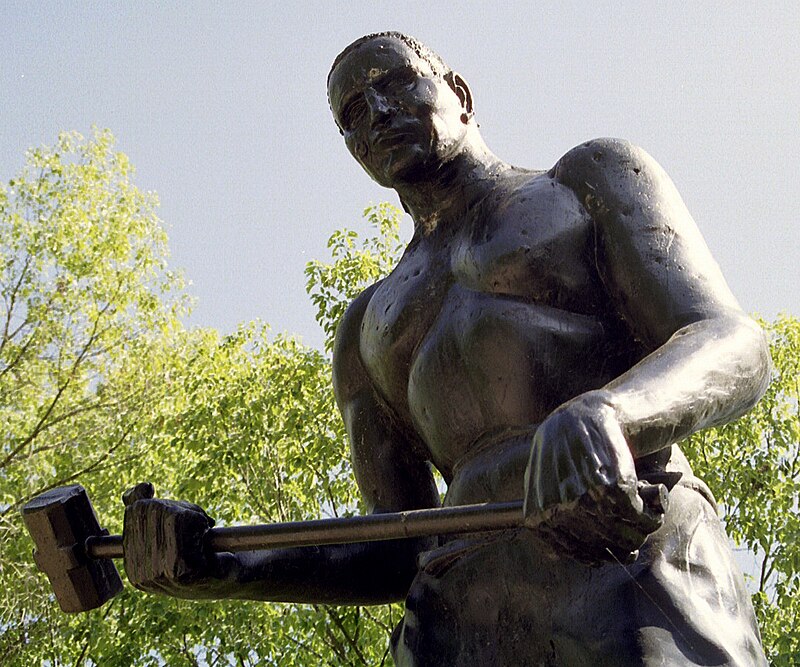
Did you know that John Henry, the "steel-driving man" of American folklore, actually existed and did in fact beat a steam-powered hammer sometime in the early 1870s, though he probably did not die from exhaustion immediately after his victory. Sadly, he very likely was worked to death as a convict leased out to the C&O Railway Company, his lungs lacerated by the rock dust he would have breathed in constantly as part of his work. How did he beat a machine? Simple--the machine was something of a rudimentary prototype, and it worked very poorly. Just a decade of refinements to the technology later, argues William and Mary scholar Scott Reynolds Nelson, and such a victory for the human would have been inconceivable.

This is a stretch, but I have esteemed myself something of a John Henry this semester in my internship project for the Florida Historical Quarterly. Largely duplicating the efforts of an earlier digital humanities project, I have meticulously-logged all 1,794 FHQ articles from the first volume in 1908 to the most recent third issue of volume 95. Why? Two reasons. 1) I wanted to perform a close survey of all 95 volumes, to get something of an intimate feel for the first century of the Quarterly, and 2) I do not yet trust optical character recognition (OCR). It does fine more than 90% of the time, but somewhere between 1 in 10 and 1 in 20 words get garbled, and for me, that still has the human winning the race.

So now I have an index, in chronological order, of some 1,800 featured articles (excluding all the book reviews), and now I have to figure out a meaningful mode of analysis, and on the double. I know I want to categorize them, and have the flexibility to acknowledge overlapping categories, e.g., Native Americans, economics, Seminoles opening a casino is both. My problem is figuring out what categories to go with, because once I start, I don't want to get to article 650 and realize I should have been tagging articles of x type. To a great extent this is a crystallization of the whole historical project: you analyze a topic in history, anxious not to miss something, but you have to remind yourself that a solid contribution is a far more realistic and likely worthy goal than the definitive, fully-exhaustive treatment. We will always miss angles of analysis, and all to the good; it gives our colleagues and posterity something to do with their scholarship. Now, time to get back to driving these spikes...

Sunday, March 25, 2018

...(Post) Secondary Education Continued...

In my last embarrassingly-wordy and somewhat stream-of-consciousness post, I enumerated six principal stakeholders involved in high school education:

1) State Department of Education
2) Scholars in higher education
3) County and school administrators
4) Teachers
5) Students
6) Parents

While higher education does not have to deal with *quite* the level of bureaucratic oversight, they have their own initiatives, endowments, and strategic vision hoops to jump through, so both groups may benefit from some reflection on the principal concerns of each of these groups. Let's take a blog-level survey:

Any state department of education has one major consideration the other groups do not, at least to near the extent: politics. They have to worry about cultural bias in math questions, so you better believe those near the top of bureaucracy are deeply concerned about minimizing the angry op-eds from parents decrying the marginalization of one group, the anti-American bias, the American gloss, etc...If someone in a state (or the federal) Department of Education cannot acknowledge the tension this creates between sound pedagogy and wise statecraft, that is a huge red flag.

As a general rule, scholars in higher education are probably the most difficult subjects of generalizations. This is more a hunch based on a smattering of anecdotes, but it seems that academics either esteem themselves primarily as writers or primarily as instructors (though perhaps some like to fancy that they maintain a perfect complimentary harmonization of the two). For those who primarily identify as writers, conscience rather than passion will dictate what they do with their students. For those who primarily identify as instructors and mentors to students, writing will likely come in fits and starts--too much tinkering with lectures competes with the research. I can't resist pointing out that given the universe's manifold ironies, there is only partial correlation between an academic's primary identification and which of the two is where his or her greatest contributions come. Extraordinary orators can feel perfunctory as they give high quality lectures, gifted writers can crank out high-impact scholarship in an almost desultory manner, and sadly the inverse of each of those. What does it matter? If you are working with a professor, it is respectful, and practically wise, to know which aspect of the profession gives him/her the most gratification.

County and school administrators are concerned with local politics, which includes internecine issues between the different parts of government. City councilors can threaten the job security of school board members, so you better believe that there are issues that bleed into what is required from local school boards and principal offices. The biggest difference between the county and school administrators is the proximity to the classroom, and therefore the ability to recognize what effect (if any) a policy may have on what teachers and students do. It is a sad truth that many pace guides, model lesson plans, and other support materials are produced at the county level and never get downloaded from the server on which they were first created.

Teachers come in two basic types: the inspired and the disaffected. If you are a student or parent, do your best to find out tactfully who the unquestionably inspired teachers are in your school, because getting them will make a world of difference in the student's education. It is unlikely you will get anyone to cast aspersions on any teacher, so don't try to find out who is jaded, though you'll hear some rants that give you enough information to have a pretty good idea.

Students, like teachers, are essentially binary: motivated or not. It is simply stunning how many educators are content to only worry about the motivated. While I understand the temptation, it belies some intentional amnesia about the experience of life from 5-18 years old. Even if you have always been a naturally curious, self-motivated student, there were some areas of life you needed some graciousness, and were not helped by "tough love" that refused to extend to you any of it. Think of the kids who are missing out on your subject because of a lack of inspiration, and try to sympathize and supply it. I have known of several teachers how were able to teach a lot to unmotivated students almost solely because of the compassion they showed them at the situation of having to learn things you're not interested in.

Finally, parents: universally they want to know that you care about their children. Some rationalize dishonesty and disregard for anyone not in their family when dealing with educators, but even when they fight dirty, they're way more inclined to accept defeat if you repeatedly demonstrate and verbalize your concern for the student. This does not resolve differences of opinion over what is best for the student, but it helps.

Reviewing this initial look, I hope it has some merit--it's admittedly a somewhat haphazard collection of observations. That said, let me know if you see anywhere I'm way off base or missing something far more significant.

Saturday, March 10, 2018

Primary, Secondary, and Higher History Education

One of the chief reasons I decided to pursue an M.A. in History was the gulf I recognized between the Academy and the K-12 educators who prepare students for its rigors. After teaching a couple years, it was evident to me that the opaque group that formulated the standards and their benchmarks at least consulted scholars from higher education in history, but there was a lack of appreciation of the inspiration and empowerment called for in the curricula. Simply put, a lot of my high school history teacher colleagues had no clue what the standards they were supposed to be teaching were getting at. In some cases, they were passionate and highly competent history teachers who recognized little value in the list of items; to them it was little more than a distraction from the coherent and nuanced picture of the past they were trying to help their students to see.

The issues here are manifold. When it comes to primary and secondary education in the United States there are no fewer than six distinct groups: 1) the state government that oversees the codification of standards, at least in consultation with 2) scholars in higher education, 3) the county and school administrations that supervise the standards' implementation and (try to) provide further clarifying guidance to 4) teachers who gaze upon the texting 5) students, whose 6) parents will let them know quickly if something is not working. Just a cursory survey of all the interactions in that network could fill up more than one blog post, so I'm going to ease into this with just one observation between two stake-holder groups, and perhaps make this a running blog series.

One of the most essential disconnects I have recognized between passionate and inspired secondary history teachers and their counterparts in higher education is their approach to narrative. At the collegiate level, the pedagogical rhetoric is almost anti-narrative. The past is always more complex, nuanced, problematic, messy, etc... Every narrative is an oversimplification. I agree with this.

At the primary and secondary level, teachers are attempting to fill what they see as basically a vacuum of knowledge--a lack of narrative. I actually agree with this too. Almost any narrative that gives meaning to generally-accepted facts about the past is welcome unless it is overtly hateful, e.g., few teachers will scruple a student sharing with the class the prophet Mohammad's young brides, the bloodbath upon the overthrow of the Umayyad dynasty, and/or some of the more unsavory elements of early Islamic military expansion as part of a summary judgment on the religion and its adherents. (Sadly, I think most teachers would shut it down by pulling rank rather than with counter-evidence. I'd point out to the student that the New Testament book of Philemon consists of Paul writing a letter to a slave-owner with the runaway slave he's sending back to him; Constantine had his nephew and then sister executed mainly out of paranoia, and the conduct of the Crusaders' conduct toward Jews and Muslims was pretty abominable, and all that might not be a fair representation of the entirety of the faith, but now more than half this paragraph has become a digression.)

The point is that collegiate educators take a narrative for granted--the students get it from movies, parents, or popular culture, but high school history teachers can attest that the narrative tabula rasa we're born with can endure far longer than those who love history are inclined to admit. My prescription is for high school teachers to state explicitly those points they are aware some facts are getting amputated to fit the Procrustean bed of this initial narrative, and collegiate instructors should appreciate the possibility that some students have previously missed the establishment of a narrative.

Friday, March 2, 2018

Making a Movie vs. Publishing a History Monograph


Earlier this week I had a conversation with Dr. Lester about publication companies. It started with a press of second-or-third-tier distinction being footnoted with the wrong city. She knew that it had moved, and previously she had demonstrated knowledge of other publishers who have tweaked their names back and forth over the past several decades. I was impressed, but also had a hunch.

Hearing her reference publishers made me think that they are analogous to film directors, in that both can give a person a good idea of what they might see if they consume a given work. She said there was something to this, so I thought I'd run with the analogy a bit. America is a nation of cinephiles, so I trust there is some value here.

Both a history monograph and a movie share three broad actors: the writer(s), the producer(s), and the director(s). In both cases, many, many, more screenplays and books are authored than get produced, and only a portion of those ultimately go all the way through production to distribution. Many people watch movies just based on trailers and a favorite actor, but production companies often have a type of movie (or a few) that they make, and so if you like that type of movie it helps to pay attention to that production company. A24 makes off-beat films like The Disaster Artist or Lady Bird,
Bay Films makes big budget action movies like the Transformers and Armageddon, etc... Similarly, certain publishers specialize in the best books on certain subjects, e.g., University of Chicago Press should be consulted if you're studying the history of architecture, the Midwest, or economics...and I've just kicked this rock over so I don't have the knowledge base yet to cite further examples (even that one is a bit shaky).

As with so many analogies, analyzing where it does not work is almost as illuminating as the places where it does. A movie has a whole host of people involved in the filming of the movie, that long list of people that scrolls as we file out of the theater. Then test-audiences, further edits, etc...A book has its principal author(s), perhaps a supporting research assistance, consulting colleagues, and its source materials, but that is pretty much it. It is interesting to consider the parallel between the end credits and the bibliography though--in both cases the people but for which the preceding work would not have been possible. What are other connections and dissimilarities between book and film production?

Friday, February 23, 2018

The Cursed Question

If Clio is your girlfriend, you'll be asked from time to time, "Why her?"

"What do you like about history?" "Why do I have to study history (the perennial question of hundreds of thousands of ninth graders)?" This question is absolutely tortuous to most people who love history. Why? Question, why do I hate thee, let me count the ways.

First and foremost, both the value and interest of history is so self-evident to those who love it that there is always an instant tinge of sadness that it has to be explained. Imagine that a friend who has a six-month-old asked with total earnestness, "What are the reasons that people like their kids?" You can explain the wonder of making new life with another person, the awe at having someone 100.0% dependent on you, but at the back of your mind you'll be thinking, "Why am I having to explain this?"

Closely related, because the pressure is on to justify something tremendously important, there is almost always a sense of inadequacy to the task: too terse and uninspiring, rambled too long and reinforced the stereotype of the history windbag, too narrowly defined or idiosyncratic. I know I always feel a certain burden not just to answer the question, but to inspire the questioner to feel the answer, to recognize that ignorance of the past is to be a kind of orphan. Thus the tepid, "Okay" in response to my explanation will always sting.

Then there is the inner turmoil. Any historian simultaneously knows that 1) everyone should know history for rock solid reasons of virtue and 2) the love of history, almost like romantic love, is animated by matters of personal preference. In the course of answering this dreaded question I often realize that why I should study history and why I actually study history are quite distinct.

This naturally leads into the affliction I'll call the embarrassed romantic. To anyone who continues the slog through academic history, his ability to keep putting one foot in front of the other has to be at least partially attributable to an idealism that makes him squirm to expose nakedly to the acid of cynicism. My canned bit on this is that I hope that when people see the chain of some 200 generations of their family going back through the 5000 years of recorded human events into the mists of prehistory they have a greater reverence for the links that came before and will come after them--we're just one single link between our ancestry and our posterity. I like to think that I bat about .300 on that having any effect on my listener. When I strike out, I feel that self-doubt that maybe I'm just boring people with what fascinates me with the additive of self-importance.

There are many more reasons the question is loathsome, but I'll wrap up there and say this: any historian should consider it a duty to craft personally an answer to that question that fits each listener--you better not say the same thing to a fifth grader that you do the entrepreneur in his mid-30s who fancies himself a futurist and remembers only dates and unrelatable dead people from his history classes. Barbara Tuchman, whom I consider one of the best historians of the twentieth century, wrote, "Why cannot history be studied and written and read for its own sake, as the record of human behavior, the most fascinating subject of all?" I feel you Barbara, I really do, but to answer your question, because many who study, write, and read, don't get it, and we have to give them more help than the Kantian principle.

Friday, February 16, 2018

Specialization and Obscurantism

It's been a little over 20 years since the physicist Alan Sokal spoofed Duke University's journal Social Text with the satirical "Transgressing the Boundaries: Toward a Transformative Hermeneutic of Quantum Gravity," in which he argued in totally meaningless, turgid language for the nonexistence of gravity, and indeed, reality itself. The "Sokal Hoax" is an outlier of editorial misjudgment, but I fear that the Academy was too quick to dismiss it as such and has still not taken the incident's full import to heart. The specialized terminology should provide progressively deeper understanding and clarifying language, and accessibility to an intelligent layperson should be among a good scholar's goals. I'm not sure why the dictum to use the most common word that fits the bill is so resisted by modern scholars, but I cannot help but suspect in many cases it is a cloak for unoriginal and/or weakly-supported ideas. Some of the early Critical Theorists were perhaps attempting to engage in a discourse that could get them fired from their university posts by using equivocal, and therefore plausibly denial language, but I doubt that has ever been the true explanation in most cases.

Here are some principles I think that many contemporary historians need to consider:

  1. Historians should write to help their readers understand.
  2. Problematizing is valuable to clear away (oversimplified) misunderstandings, but the vacuum should be filled. People rarely abandon an explanation without an alternative to take its place.
  3. All knowledge, all people, are unified, so understanding is never complete. A historian can help to understand a part or a few parts of the past--defining what part(s) is a critical step to a good scholarly work. 
I hope all my work passes the muster of these starting principles (moving forward)--it is not my goal to transgress their boundaries.

Sunday, February 11, 2018

Passion, Bias, and Audience


The inspiration for this essay is somewhat sensitive material, so I'll have to be circumspect--fortunately I am all-too-comfortable with abstraction: if you write without passion, without at least a strong sense of purpose (beyond a deadline, in this case one past), your readers will likely be bored. It will be clear that you do not care much, and so why should they?  That same passion essential to lively writing, however, can cloud your judgment in myriad ways and doom your work to mediocrity--inadequately-supported arguments (it seems obvious to you), glossed-over weaknesses, snarky comments that alienate the unconvinced and repel those who expect fairness to all sides.

There is a reason passion is often linked to the metaphor of fire.

The best way I have found to modulate my biases effectively, is to imagine a reader who is basically like me, but for one basic difference: all of his life experiences make his intuition or gut lean the other way. I think people are naturally selfish, this person had an early indelible encounter with someone winsome who convinced him that at worst we live in a tension between our natural altruism and the desire for personal gratification. Things have generally worked out well for me, while this person has known innumerable unjust encounters with chance and his fellow human beings.

To be clear, I do not think in these biographical terms; whatever I am arguing, I imagine a person who sees some of my self-evident or probable premises and doubts every one of them. In brief, this gives me a fairly reliable Muse, even if she is something of a taunt. Who do you imagine when you write history?

Friday, February 2, 2018

Experience and Interest

In 1985, Gary Larson's off-beat newspaper cartoon Far Side featured a single panel, one which many found utterly inscrutable. It shows an old wizened traveler in a wagon pulled by two oxen moving from left to right across a desert landscape. The man looks straight ahead with an expression of bored detachment, but the two oxen's heads are both craned hard to their right, more or less looking toward the viewer. In the foreground, resting in the sand, is the large skull of a steer. There is no caption. In his post-retirement retrospective The Prehistory of Far Side, Larson testified to receiving many letters from confused fans puzzled, unable to find the joke. (I would reproduce the cartoon, but since his retirement Larson has explicitly requested that people not post any of his work online. Darn artists trying to make a living.)

The "joke" is simple though, and I've always found it quite profound: we notice those things which directly concern us and our type, and have no interest in those things which don't. For historians and educators, this is a truth that in our bad moods leads us to self-righteous gloomy pronouncements about people's selfishness, but 1) this makes us far less winsome, hurting the fields, and 2) we are hypocrites: I've never met a historian who does not have some historical topics that he respects but in which he cannot muster much interest.

The key is to unpackage each criterion: direct concern and our type. The fact of the matter is those two can change, and quite dramatically. The better we understand how we form in our minds what concerns us and what doesn't, and who are like us and who are not, the better our history will be. Closely related, we need to recognize that bridging gaps of interest and identity often comes down to artistry: the Wars of the Roses are of interest to many because of Shakespeare, and the Crimean War because of Tennyson. And of course who apart from American historians and numismatists would have been able to recognize this Founding Father before 2015?

Alexander Hamilton says do not throw away your shot to reach the maximum number of people with your historical work.

Friday, January 26, 2018

Ideas: the Overlapping Categories of Old, New, and Good

Academics in general, but particularly historians, work with ideas. Indeed, ideas are the finished products. Of course, sources are (or should be) paramount, but sources of what? The sources of our ideas about the past, people's motivations, what effected change, human nature, etc... A good craftsmen will display to the market meticulously-designed tangible products, but a historian presents to the world ideas wrought from the raw materials of their sources with the tools of their analysis. Incidentally, this is why clarity is so important in scholarship: a salesman should not expect to move physical merchandise if consumers examine it and are not quite sure what it is or does, and likewise a scholar cannot reasonably expect much interest if readers are uncertain what ideas he is arguing that they accept, and/or what those ideas are made of, i.e., what sources he used. Good writing is not the concern here though, but good ideas, and their relationship to novelty.

(Quick disclaimer: if philosophically you think the idea of "good and bad" ideas is so subjective as to be devoid of meaning, I'm probably not going to have much for you here. I define good here as respecting truth and the sanctity of human life, and bad as the opposite.)

During my undergraduate studies I knew a philosophy professor who was fond of prefacing lectures with the wry remark, "May I not say anything new today." His logic was that the good life and the sound philosophy that makes it possible are not likely to be a cutting-edge developments--wisdom is gold, but foolishness is kudzu. There is enough insight there for the comment to stick with me, but of course it is not a truth universal to all contexts: while virtues may be the same at their essence across the ages, we have learned previously unknown, forgotten, suppressed or distorted details of the past. There are good new ideas in history. The idea that the people already living in the Americas upon the arrival of Europeans were not a monolith (the Savages/Indians/Natives/indigenous peoples), but separate peoples with innumerable* distinct cultures, actions, and interests was a good one: it restored human dignity to people who had previously been treated as little more than part of the scenery of the New World.

*Innumerable is often used just to mean "a lot," which applies to Native American tribes, but it literally means "unable to be numbered," and owing to inadequate surviving evidence, that sense is also true.

So ideas can be good and bad, new and old. This creates a matrix of four combinations (new and good, new and bad, old and good, old and bad), and failure to consider the characteristics of each is a bit like eyeballing measurements and not asking about common pitfalls in construction; it is the haste that writes much waste. Here are some preliminary reflections on each:

New and Good - It has to be acknowledged that this is the most valued because it is the most difficult. Every semester educators from high school teachers up to thesis advisers must break the news as tactfully as they can that no, that idea is far from new, or huh, that idea is utterly bizarre. It's also worth noting that throughout the ages many people have rejected ideas as bad because they are too counter-cultural, and they generally deem them "stupid" rather than "too counter-cultural." That said, pride can make an ignorant person declare, "They are not ready for my ideas," when really, the ideas are just bad.

New and Bad - Though there are many charlatans in the world, most who argue bad ideas are sincere: they think their ideas are good. You should give a LOT of thought to the various causes of poor judgment, e.g., (sleep-deprived) desperation on account of a publication or assignment deadline, pride making a person resist honest consideration of counter-arguments, bad ideological dogma, etc...Do you feel comfortable that you are not susceptible to any of those issues? Don't.

Old and Good - This category is sorely undervalued. Who really gets excited by the prospect of verifying the truth of an accepted fact? That is not actually a rhetorical question. The answer is the person who recognizes that many old "good" ideas turn out to be bad, and that even a good accepted idea does not animate positive action near as powerfully as a good idea fueled by a lot of compelling evidence. A lot of movements begin with someone passionate about proving more forcefully an old idea that is popularly-but-complacently accepted.

Old and Bad - These ideas persist for a reason (actually many reasons). Make sure and establish the grounds on which you reject the old idea as bad, and then theorize why it persisted so long (in that order, and make sure not to be too flippant on the second part). When doing scholarship on an old bad idea--phrenology, scientific racism, the Inquisition--a common mistake is to take for granted the obviousness that the idea is bad. This assumption can make readers think the author is undecided on the matter (or in some cases that he supports the idea), and/or can lead the historian to fail to fight a misconception he hates, because he fails to recognize the continued need to do so. While phrenology is a byword for bad pseudo-scientific ideas, many historians treat racial issues with a reckless false presupposition that readers hold no racist ideas, and while the Catholic Church has apologized for the Inquisition, the question of the relationship between coercion and orthodoxy is much murkier than most people naturally think.

Look back over the descriptions above--what prominent and/or important features of each am I missing?

Friday, January 19, 2018

Identifying Groups, or Words as Live Wires


In my study of the Linguistic Turn in Historiography last semester, I began to recognize more fully how much hidden freight there can be in word selection. The tired example is "revolutionary" or "terrorist," but it has become so cliche that its power is greatly diminished. The more topical case that I confronted was the label to apply to the events in Los Angeles in 1992 following the announcement of the verdict in the Rodney King case. After an embarrassing amount of thought, I concluded that the use of "riot" generally implies a critical, holistically negative judgment, "civil unrest" is neutral, and "violent protest" conveys sympathy with those who expressed outrage at the verdict in the streets*.

One of the categories where this is the most perpetually-fraught is demonyms, e.g., Indians, Native Americans, Natives, Amerindians, Indigenous Americans, etc... A lengthy linguistics paper would probably be required to treat this topic comprehensively, so with a humble hat tip to Montaigne I will content myself with some general observations on the matter.

First, there is a fluid periodization of the most popularly-accepted term for a group. The people English colonists encountered were generally "Savages" at least through 1776 (the Declaration of Independence used the term), but by 1787, the Constitution was excluding "Indians not taxed" from representative apportionment. By the second half of the 20th century, the preferred term changed quite rapidly more than once with a lot of discord on the subject.

Second, there is a strong correlation between politics and terminology, and a common power play is to explain what the Other means in their use of a new term, often with a certain conspiratorial distrust ('They say it is about respecting x, but really it is an insult to y'.)

Third, in light of the first two, it is important for a historian to demonstrate knowledge of the periodizations and politics of words, and to show a certain measure of humility on that score. The natural starting position is one of ignorance, and so this can take a lot of work, a lot of reading and analysis, but that is the essence of historical scholarship. To be blunt, there is no way around the fact that if you betray a lack of awareness of the freight in a certain term's use, you have to admit that you missed something important.

Fourth and finally, because people start out unaware of terms' baggage, inferring anything absolutely is foolish. If a person uses a word that as a general rule would put them in a certain political camp, a scholar (or conversationalist) should ask a clarifying question and/or look for further evidence before concluding that they are part of the camp. The argument that "he should know the history of that word" only goes so far--we all should know more.

*I emphasize "generally," because of the simple truism that we often do not say what we mean. So, a participant defending his actions might have told the television cameras, "THIS is why we're rioting"--certainly not implying an unconscious negative assessment of his conduct.

Tuesday, January 16, 2018

Belated Week 1

Albert said (if memory serves me) that true genius is the ability to focus on one thing at at time. What a luxury.
One of my favorite anecdotes from the Cold War is that a general advising Stalin during one of our episodes of brinkmanship counseled caution based on the time he spent in New York City: "Comrade, if we go to war now, it will be chaos, and the Americans will win, because they live with chaos everyday." While it is likely apocryphal, it sure does capture American life--we're either busy or bored, with no in between. Last week I piled on this internship with the Florida Historical Quarterly on top of my full time job with Florida Virtual School, and two boys, ages 2.95 and five-months (I'm compensating for my uncited anecdotes with pedantic precision on the ages). So naturally, I'm wrapping up my first week on Tuesday of the following week. I'm sure I'll be all caught up by Friday (see picture above).

My first project is copy-editing an article for the Fall 2017 Quarterly--it gave me a chuckle last week to learn that the journals of state historical societies are notoriously back-logged. For example, the Journal of Mississippi History last hit its subscribers with an issue in the summer of 2013*. I believe Dr. Lester when she says we will be caught up by the end of 2018, but I think Mississippi might need to think outside of the box. (That said, it is my fervent hope that sometime soon they release an issue titled "Fall 2013" with no comment.)

I typed a substantial paragraph on the article I am reviewing, and then realized that I am uncertain whether or not my bosses would be pleased with me providing a preview of the content we will soon release, even if this blog's readers are likely to number in the single digits. I'll confirm that this is okay, and put that into my second post. I can think of no more fitting way to conclude my first reflection than to note that I now need to switch to the task of logging my hours for the first two weeks of December for the fine people of Florida Virtual School (the full-time job).** You don't want our chaos North Korea.

*http://www.mdah.ms.gov/new/interact/subscribe/journal-of-mississippi-history/
**To be clear, I did not have credentials to the system to log said hours until the end of last week, and was just told that I need to perform some personal anthropology on what I was working on--still too fitting with the theme not to share.